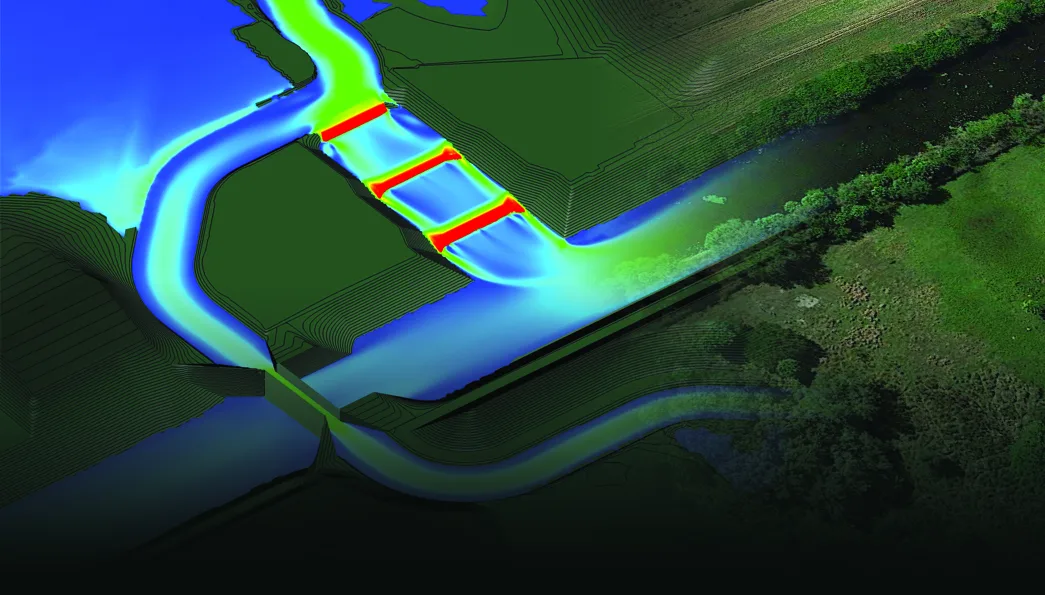
The metropolitan area of Fargo, North Dakota, and Moorhead, Minnesota, is prone to flooding, with flood-related impacts costing the region millions of dollars. The Fargo-Moorhead (FM) Area Diversion project establishes permanent flood protection measures for the region.
The $2.2 billion project involves a diversion of the Red River through a 20,000-cubic-foot-per-second, 30-mile-long, 1,500-foot-wide diversion channel with 32,500 acres of upstream staging area, or 150,000 acre-feet of volume. The FM diversion will reduce a 100-year flood event from 42.4 feet in elevation to 35 feet at the Fargo gauge. For comparison, the 2009 flood of record peaked at 40.8 feet. The staging area is used only for flood events exceeding a 10-year storm, or aproximately 35 feet at Fargo.
Hydraulic modeling by Bergman-Hanson JV
The U.S. Army Corps of Engineers (USACE), St. Paul District, selected the Bergmann-Hanson-HDR JV team to develop two-dimensional (2D), three-dimensional (3D) and physical models in conjunction with the design criteria for an aqueduct carrying the Maple River and Sheyenne River over the Red River Diversion Channel around Fargo.
The JV team was part of a larger team of hydraulic modelers, including USACE staff, responsible for formulating and implementing a work plan for the various aqueduct structure models. The team developed a detailed scope of work for modeling alternative configurations of the channel realignments, spillways, and aqueduct designs to carry the Maple and Sheyenne rivers over the Red River Diversion Channel.
Hanson led the 2D modeling effort, developing terrain and two-dimensional mesh in the U.S. Department of Defense Surface Water Modeling System (SMS). The team used Adaptive Hydraulics (ADH) – a modular, parallel, adaptive finite-element model for flow and transport – to simulate multiple alternative project configurations. ADH is a module of the SMS and Ground-Water Modeling System.
Using a geographic information system, SMS and ADH, Hanson developed 2D hydraulic modeling of existing and proposed configurations to assess system performance. The analyses considered effects of ice, sediment transport, erosion/scour and fish mitigation objectives.
The numerical modeling program was coordinated with a 3D model and a physical model developed by St. Anthony Falls Hydraulic Laboratory. The team also collaborated with USACE’s Engineer Research and Development Center and the Cold Regions Research and Engineering Laboratory.
ADH was used to model the optimal project configuration, which was selected during a value engineering design charrette. Hanson then developed design criteria for the USACE design team.
Project recognition from SAVE
For their efforts on the project, the St. Paul District and its team members were presented with the 2013 Outstanding Value Methodology in Government Award from the Society of American Value Engineers (SAVE) International, during the SAVE Value Summit. The award recognized the Fargo-Moorhead Metropolitan Area Flood Risk Management project for outstanding use of value methodology, which resulted in $279 million cost savings to the project and a return on investment of 740-to-1.
The award nomination included three value engineering studies and two value-based design charrettes conducted for the project.
Ninety-one participants and facilitators were involved in the success of the studies, including local sponsors, consultants and USACE personnel.