 |
For more information about digital tower control center installations, contact Blake Swafford, Hanson’s regional vice president, aviation, at bswafford@hanson-inc.com. |
The first airport in the U.S. to operate a Federal Aviation Administration-certified digital tower is a World War II-era facility that started as a training ground for the U.S. Army Air Corps soon after the war started in 1941. Bartow Executive Airport, in Bartow, Florida, bore the name Bartow Army Airfield at its conception, and in 1955 became Bartow Air Base, a military flight training center.
The city of Bartow assumed the airport’s ownership in 1961. Its operation and oversight transitioned to Bartow Airport Authority in 1967 via a special act of the state legislature that established a dependent special district, and the facility continues to serve as a primary pilot training center. In keeping with its rich history, Bartow is embracing the future as the home of the digital tower control center (DTCC), which will initially serve as a training facility and eventually be used to direct Bartow’s air traffic.
Aiming high
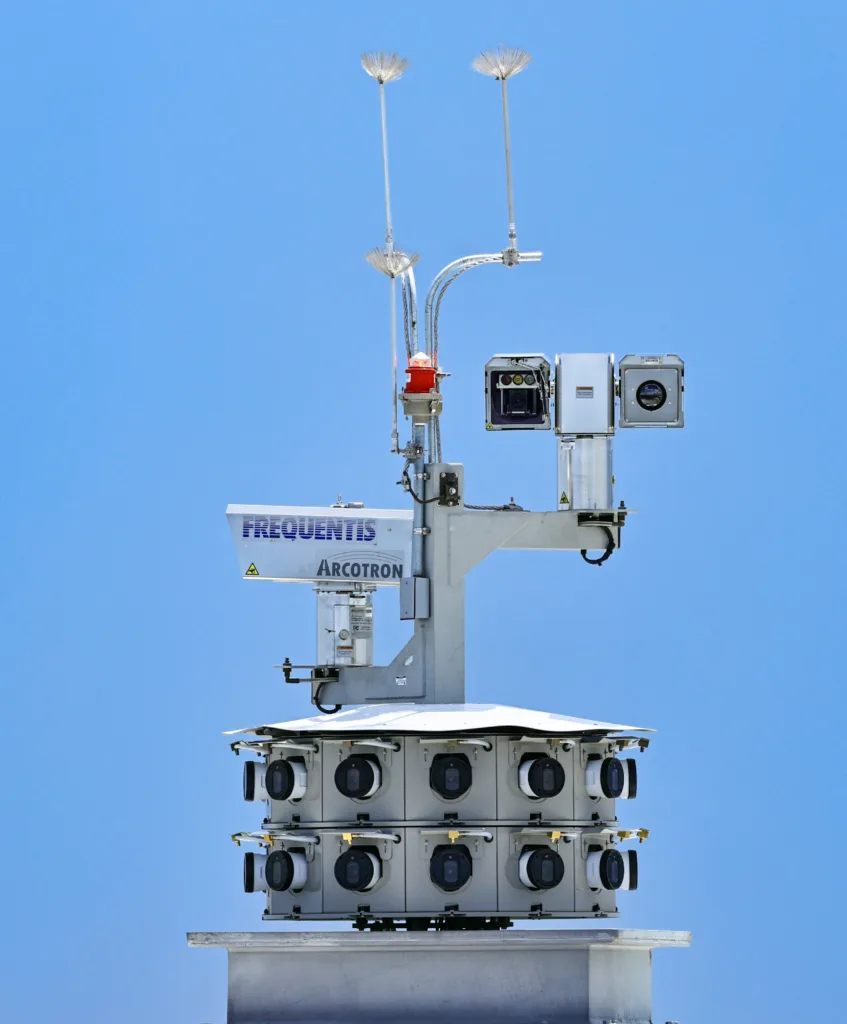
Hanson has provided engineering and construction support services for the digital tower, which provides air traffic services remotely through direct visual capture and visual reproduction via cameras. A remote tower module, which includes operator workstations, air traffic management systems and display solutions, facilitates air traffic services. The project involved renovating a building to be used as the DTCC. The work scope encompassed new heating, ventilating and air-conditioning equipment; electrical panels and wiring, with the addition of a backup generator; plumbing; a roof; hurricane-proof external doors and windows; flooring; and the addition of an information technology room, including new fiber throughout the building and fiber connections to the digital tower. The project also included location analysis, structural design, foundation design and power to the remote tower.
Budget-friendly innovation
Hanson coordinated closely with the Federal Aviation Administration while implementing Bartow’s digital tower. The cost to build the digital tower was about half as much as a traditional air traffic control tower (ATCT), and Bartow’s future maintenance costs are expected to be a fraction of the amount of the costs for a traditional ATCT. Bartow’s digital tower control center is designed to accommodate up to six airports’ digital towers, which will further improve efficiency by reducing each airport’s operational and maintenance costs.
The digital tower also increases Bartow’s safety with pan-tilt-zoom cameras that employ visual and infrared sensors, along with light gun capabilities. The cameras’ bounding box function allows controllers to easily track aircraft in the flight pattern and identify in-motion hazards, both airborne and within the movement areas on the ground. Hanson incorporated redundancies in the digital tower, further reducing risk.
For the digital tower project, Hanson functioned as the designer and general contractor, working closely with the digital tower software and hardware vendor Frequentis.