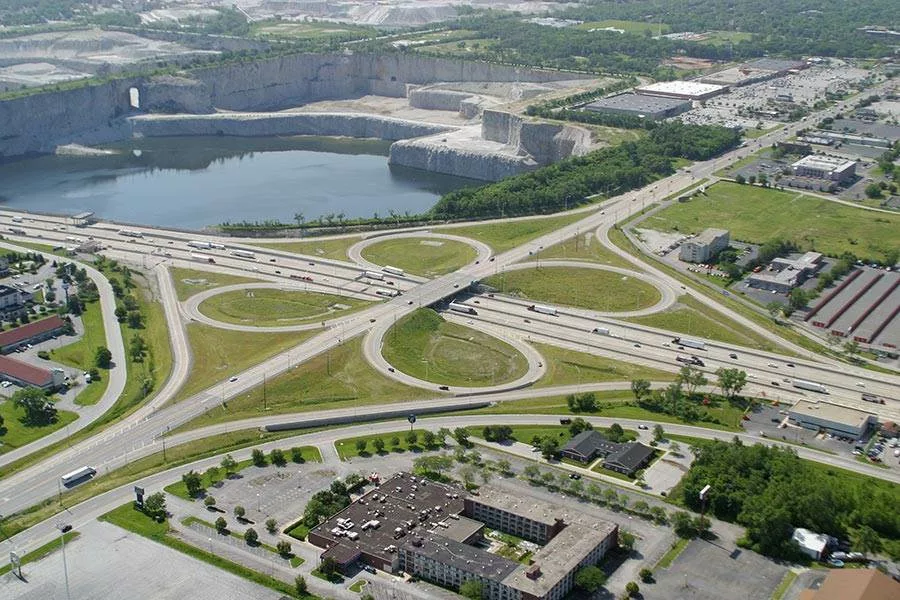
In 2001, the Illinois Tollway initiated a rehabilitation project for the South Tri-State Tollway, focused on pavement patching, resurfacing and bridge repairs. Hanson was selected as the design consultant for the segment extending from the I-80/I-94/Illinois 394 interchange to the Markham Yard Bridge.
As the tollway’s traffic studies and growth forecasts were completed during the early phases of design, it became clear that rehabilitation alone would not accommodate the corridor’s rapidly increasing traffic demands. Rather than investing in short-term improvements, tollway officials determined that a full reconstruction and widening program was needed to address long-term congestion and improve mobility along one of the region’s most critical freight and commuter corridors.
The subsequent improvements were among the first projects completed in the Illinois Tollway’s Congestion-Relief Program (CRP), transforming what began as a rehabilitation effort into one of the program’s first major corridor reconstruction projects.
The upgrade expanded the project scope to include the widening and reconstruction of 3.6 miles of I-294 and I-80 between the I-80/I-94/Illinois 394 interchange and the Markham Yard Bridge. The $136 million project, which Hanson began designing in early 2002, included four pairs of mainline bridges, three local street grade separations, two railroad grade separations, the Halsted Street interchange and the Lincoln Oasis service interchange.
‘Continuous communication and collaboration’
John Nelson, P.E., served as Hanson’s project manager, leading the team through the dramatic transition from a rehabilitation project to a full corridor reconstruction. The change required reconsidering the design from the ground up while maintaining an aggressive schedule, managing costs and meeting the tollway’s delivery expectations. John assembled and coordinated a multidisciplinary team of 40 to 50 professionals from Hanson offices across the Midwest, helping deliver the project on schedule and within budget.
David McDonald, Ph.D., P.E., PTOE, served as assistant project manager and project engineer, leading Hanson’s roadway designers and coordinating efforts among Hanson disciplines and external project partners. Many of the project’s roadway designers were early in their careers, adding to the team’s mentoring and coordination responsibilities.
“The coordination effort was enormous,” David said. “With roadway, structures, drainage, maintenance of traffic, lighting and other disciplines all working simultaneously, the project reinforced the importance of continuous communication and collaboration across teams. A number of the young designers who contributed to the project are still with Hanson today.”
David also managed design submittals and comment resolutions throughout the project. “We predominantly used paper for submittals, but we still had a set of original, full-size mylar sheets,” he said. “There were 2,521 sheets across 14 volumes in the final submittal. Coordinating contributions from dozens of team members while maintaining consistency and incorporating evolving tollway standards was a significant undertaking.”
‘STILL WITH HANSON TODAY’“A number of the young designers who contributed to the project are still with Hanson today.” — Technical Discipline Chief (People Manager) David McDonald, Ph.D., P.E., PTOE
“I learned from and worked with some great engineers on that project,” said David, who is now a technical discipline chief (people manager) in Hanson’s roadway discipline. “All the meetings were in person. Times were different then.”
Just three months after joining Hanson and while still a student at the University of Illinois Urbana-Champaign, assistant vice president and senior civil engineer Amber Petkevicius, P.E., served as roadway designer on the project. She highlighted the significance of the reconstruction: “The section we worked on was at the southern end of I-294, where the roadway connects directly with major cross-country corridors like I-80 and I-94. The area acts as a vital transition and connection point for heavy interstate and freight traffic moving between Indiana and the Chicago metropolitan region’s southern industrial belt. This project helped reduce bottlenecks and improve regional connectivity.”
The Hanson team designed roadway and bridge improvements that expanded the corridor from six lanes to up to 10 lanes; reconstructed the Halsted interchange; modernized toll collection facilities; and delivered comprehensive roadway, structural, traffic, drainage, lighting, utility and maintenance-of-traffic designs. The project also included geometric upgrades, noise abatement walls, retaining walls, and fiber-optic and communications infrastructure. The team also designed profile modifications to improve drainage and achieve required vertical clearances at multiple structures.
“The South Tri-State project was my first opportunity to work on major roadway design for an interchange,” Amber recalled. “I learned a lot — I was exposed to many different segments of the design process, strengthened my skills in geometric design and found my niche in large infrastructure projects.”
Project constraints
The project presented the design team with several challenges:
Mainline profile design
Some of the bridge vertical clearances were inadequate for military defense vehicles. Because the client wished to leave four overhead bridges in place, Hanson lowered the mainline profile to provide the necessary vertical clearance. When lowering the profile affected the foundations, Hanson recommended partial footing removal and other footing improvements to accommodate the changes.
Superelevation transition
To tie into existing infrastructure and preserve several overcrossing bridges, sections of the mainline generally followed the existing profile. As lanes were added and horizontal curves overlapped the gradual profile grade, the team recognized areas where pavement drainage could be a concern. Hanson used 3-D pavement surfacing in the superelevation transition areas to identify areas of concern. Once the team identified locations with an instaneous grade of less that 0.3%, they adjusted the profile as much as possible.
‘A UNIQUE EXPERIENCE’“I got to go up in a bucket truck to inspect the lighting and conduits on an overhead sign that cantilevered out over the interstate. That was a unique experience.” — Electrical Discipline Manager Ryan Nation, P.E., RCDD
In one location, adjusting the profile would not completely address the concern, so Hanson introduced a nontraditional superelevation transition to maintain positive drainage in a lane that would have been problematic without the change. According to David, “This was the first time we had used a three-dimensional visualization tool from our design software to show where we may have concern with the proposed pavement. This was a new modeling tool for us. We then worked with the tollway to develop a satisfactory, non-traditional superelevation transition through this area to avoid the potential problems this may have caused. We modeled the proposed solution and demonstrated that the problematic pavement was eliminated.”
The leader of the complex MOT task was Raul Cantu, an experienced Hanson civil engineer. To maintain the three lanes of traffic in both directions during each stage of construction while providing access at each interchange, his MOT team developed mainline crossovers and multiple temporary alignments within the interchange areas. The team used tools including the application of Method 2 superelevation design for the crossovers and temporary alignments, introduction of counter flow lanes, temporary signals and calculating earthwork by stage. The MOT team also developed specifications to limit rock blasting to 20-minute windows on Saturday and Sunday mornings.
Schedule
The client’s goal was to complete the project by Oct. 31, 2006, which required Hanson to expedite design and provide design support services during construction.
Right-of-way (ROW)
Additional ROW was limited or unavailable because of environmental constraints including endangered orchids, native American artifacts, a quarry and commercial buildings.
Quarry
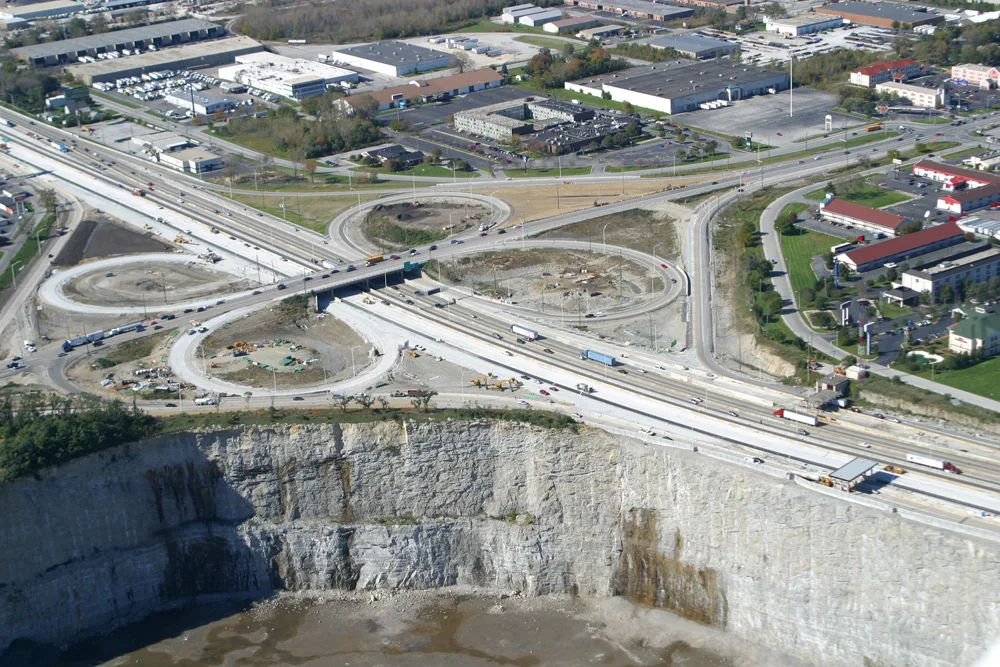
An active rock quarry, east of the Halsted Street interchange, constrained the geometric design of the two ramps in the southeast cloverleaf quadrant, the southbound collector-distributor roadway and the new toll plaza.
Rock and other soil conditions
The nearby rock quarry suggested that the team would encounter rock elsewhere along the project corridor.
The soil borings indicated rock was present at an elevation that could impact construction within one third of the project limits. Removing the rock required special attention during construction. The Hanson team developed an approach to minimize the amount of rock needed to be cut for drainage pipes and drainage structures in these areas. The team also found poor soil conditions at the east end of the project.
Budget
The construction budget design budgets were constrained. If the construction amounts exceeded the budget, the client would not be able to complete all planned improvements. Hanson delivered a design within budget. At the time, this project was the most expensive tollway project advertised for construction.
Working high above Thornton Quarry
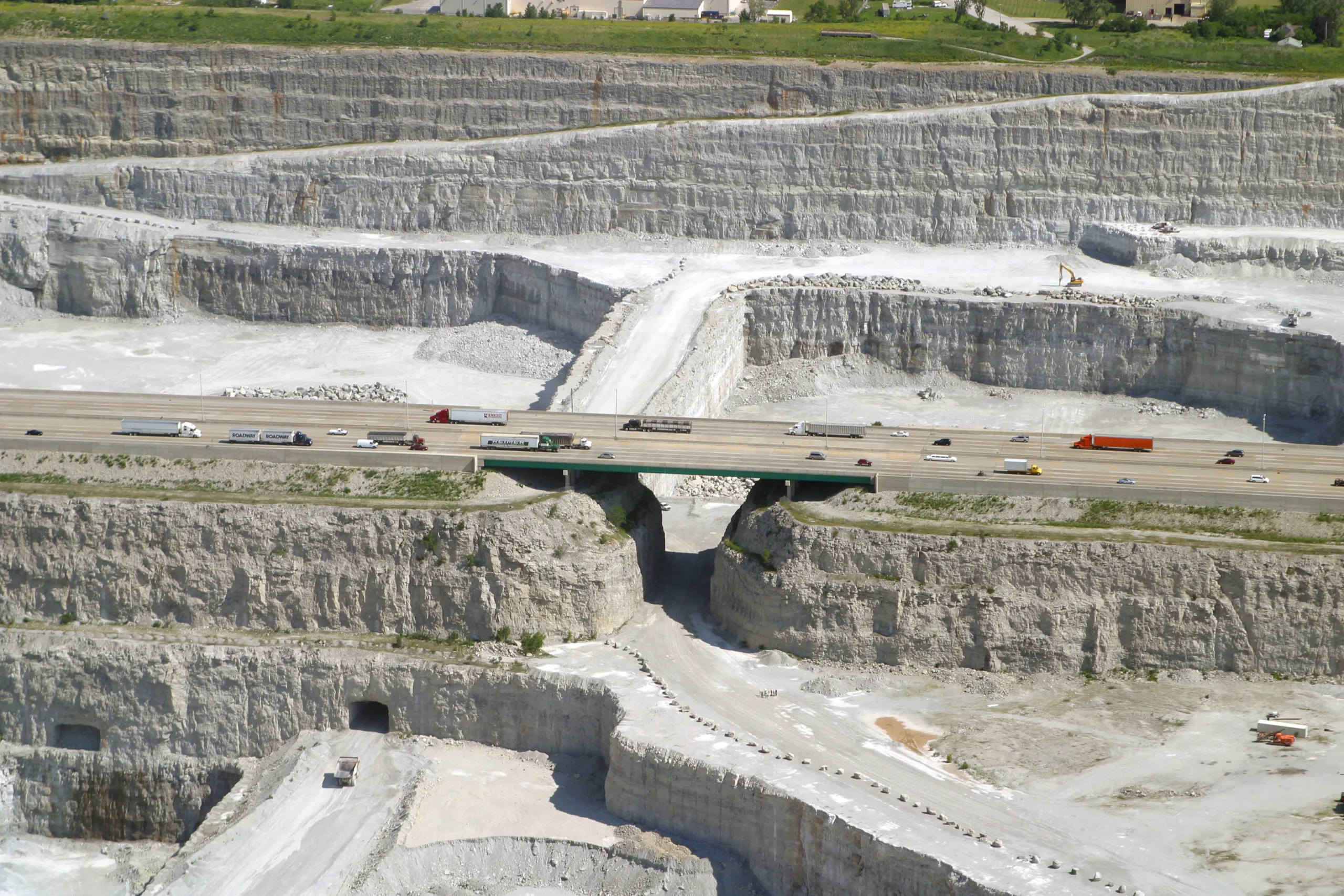
The corridor also passed through deep limestone rock cuts adjacent to Thornton Quarry, requiring complex geotechnical, grading and drainage solutions. To address the extensive rock excavation, Hanson introduced design and construction practices commonly used in mountainous regions, including controlled blasting techniques to allow for safe and efficient rock removal.
‘ESPECIALLY MEMORABLE’“On some of the longer-span structures, the inspection experience could be especially memorable. As heavy trucks traveled through adjacent open lanes, the bridge deck would visibly deflect beneath us, providing a very real appreciation for the scale and flexibility of these structures.” — Hanson Assistant Vice president and Project Manager Andy Nicol, P.E., S.E.
High traffic volumes exceeding 136,000 vehicles per day, including a significant percentage of heavy trucks, posed challenges for data collection, field investigations and construction staging. Hanson conducted extensive nighttime inventories and inspection operations to safely gather critical design information.
“The South Tri-State project was the first major assignment of my career, and it provided an unforgettable introduction to bridge inspection work,” said assistant vice president and project manager Andy Nicol, P.E., S.E., who was a design engineer for the project. “My role involved inspecting numerous structures along the corridor, both during daytime access periods and through extensive nighttime field operations. At the time, bridge deck assessments were largely performed through hands-on, manual inspections. During overnight lane closures, our teams would work directly on the bridge decks, often on our hands and knees, carefully documenting cracking, deterioration and other conditions. On some of the longer-span structures, the experience could be especially memorable. As heavy trucks traveled through adjacent open lanes, the bridge deck would visibly deflect beneath us, providing a very real appreciation for the scale and flexibility of these structures.”
“The Thornton Quarry was an interesting feature to redesign an interchange around,” said vice president and transportation practice lead Matthew Dawson, P.E., PTOE, who served as a roadway designer for the Halsted interchange.
Hanson electrical discipline manager Ryan Nation, P.E., RCDD, contributed lighting design for the project. He provided the electrical design to remove the lighting system and redesign a new system in accordance with the Illinois State Toll Highway Authority standards of the time. “My role included interfacing with the street lighting system to provide a power feeder for the new lighting system and calculations to determine uniform lighting for the vertical face of the sign,” he said. “I got to go up in a bucket truck to inspect the lighting and conduits on an overhead sign that cantilevered out over the interstate. That was a unique experience.”
Fielding calls on Sept. 11, 2001
Sept. 11, 2001, was the team’s first day of onsite work. As the project manager, John was coordinating traffic control for the next day when his wife called to tell him an airplane had hit the World Trade Center.
Andy recalled that the inspection team was preparing to leave the office to perform an inspection of the bridge carrying I-294 over the Grand Trunk Railroad the morning of the attacks. “Before departing, we gathered around televisions in the office as news broke of the terrorist attacks. Like everyone across the country, we spent the morning trying to comprehend the events unfolding in New York, Washington, D.C., and Pennsylvania before eventually continuing with our scheduled field work.”
‘A POWERFUL REMINDER’“More than two decades later, that day remains a powerful reminder of both the importance of transportation infrastructure and the resilience of the people who work on and around it.” — Hanson Assistant Vice president and Project Manager Andy Nicol, P.E., S.E.
Once onsite, Andy and his team experienced a day like no other. “The inspection required us to work beneath the bridge using manlifts in an area largely hidden from motorists traveling overhead,” he said. “The atmosphere throughout the day felt different – there was a heightened sense of uncertainty and vigilance everywhere. Partway through the inspection, several Illinois State Police officers arrived on site after receiving a report of suspicious activity beneath the bridge. Given the events of that morning and the concern over potential attacks on critical infrastructure, it was understandable that our presence had drawn attention. After a brief conversation and verification that we were conducting a routine bridge inspection, the officers wished us well and allowed us to continue our work.
“More than two decades later, that day remains a powerful reminder of both the importance of transportation infrastructure and the resilience of the people who work on and around it,” Andy reflected. “For me, it also marked the beginning of a career in bridge engineering, combining technical challenges, field experience and occasional moments of history that no one could have predicted.”
Adding value for the tollway
To accelerate project delivery and maximize value, Hanson included performance specifications for selected bridges, retaining walls and noise walls, allowing contractor-led final design and material selection. This innovative approach enabled the tollway to advertise the project earlier and helped reduce construction costs from the $150 million engineer’s estimate to a low bid of $136 million. Hanson also developed maintenance-of-traffic plans using crossovers and counterflow operations to maintain three lanes of traffic in each direction throughout construction.
Hanson appreciates the tollway’s confidence in our team to help deliver this large, complex project — along with an extensive team of designers, the contractor and the construction services engineer, as well as the other project stakeholders and the tollway — under an aggressive schedule. At the time, it was the largest design assignment Hanson had undertaken for the tollway, and we have been privileged to assist the tollway with several other projects since, including:
- Jane Addams (I-90)/I-39 “Cherry Valley” interchange: Conceptual, preliminary and final engineering design and construction design support for the reconfiguration and reconstruction of the I-90/I-39 interchange, which included reconstruction of 2 miles of I-90, 0.5 miles of I-39, four ramps, three bridges, five retaining walls, a portion of the U.S. 20/Irene Road intersection and a new exit ramp from I-90 to Irene Road.
- Jane Addams Tollway (I-90) reconstruction: Concept design, environmental evaluation documentation and final design engineering for the preparation of contract plans and specifications for the reconstruction and widening of a 22-mile section of I-90 between Genoa Road and IL Route 47 in Boone, McHenry and Kane counties.
- Reagan tollway (I-88) rehabilitation: Engineering services for the rehabilitation of approximately 10 miles of I-88 from Midway Road to U.S. Route 251, including resurfacing, and rehabilitation of four mainline bridges, five overcrossing bridges and nine mainline culverts.
- Central Tri-State Tollway (I-294) reconstruction: Hanson served as the corridor manager for the preparation of a master plan for a 22-mile section of I-294 from 95th Street to Balmoral Avenue; the preparation of a portion of the master plan from Cermak Road to Balmoral, including the I-88/I-290/I-294 interchange complex; and the design for 3.7 miles of widening and reconstruction, with construction document preparation for the approximately 2 miles from south of 47th Street to north of Ogden Avenue (U.S. Route 34).
An award-winning, career-shaping project
The project, completed in fall 2006, successfully expanded corridor capacity, improved safety and operations, maintained traffic throughout construction and delivered substantial cost savings through design and project delivery strategies. The project won multiple awards, including the Institute of Transportation Engineers Transportation Achievement Award, the American Council of Engineering Companies (ACEC) National Recognition Award, the ACEC Illinois Honor Award, Midwest Construction’s Best of 2007 and the National Partnership for Highway Quality National Achievement Award for Illinois.
Andy said one of the most remarkable aspects of the South Tri-State project is how much the profession has changed since then. “Many of the inspection activities that once required lengthy lane closures and direct, hands-on evaluation can now be supplemented or performed using technologies such as infrared scanning, advanced imaging systems and artificial intelligence-assisted deck condition assessments,” he said. “These innovations have improved efficiency, enhanced safety and provided engineers with more comprehensive data than we could have imagined in 2001.”
“It was Hanson’s first major tollway project and grew our team’s experience in major roadway work, leading to over 20 years of successful projects with a great client,” Matthew recalled. “It was a fast-paced and complicated project with a very dedicated team, and it taught me several important lessons that I still share with new engineers, interns and students.
“When you think about how many people use this section of interstate on a daily basis, it is pretty cool to have been a part of making it better.”